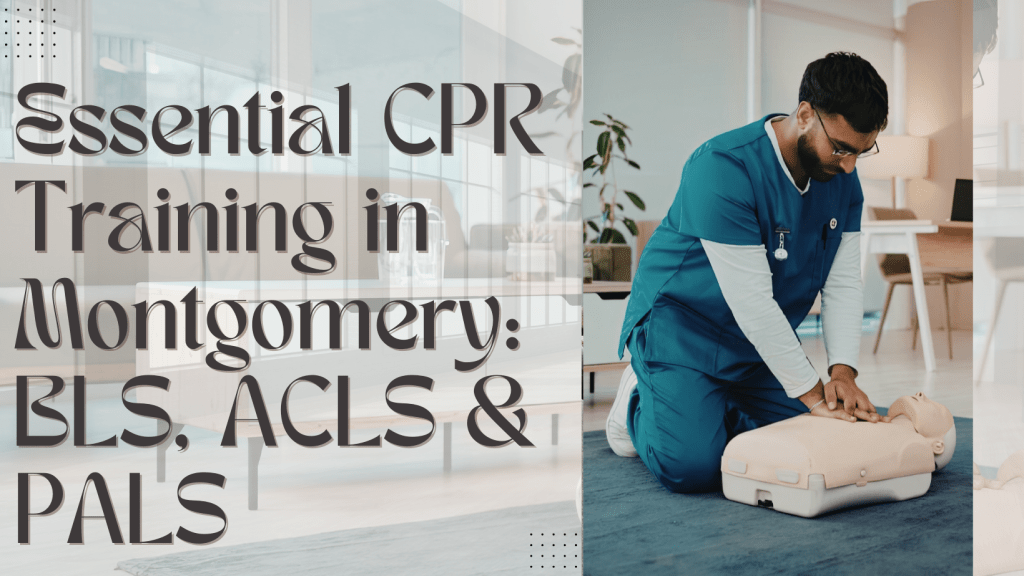
For healthcare professionals and private citizens alike, possessing the ability to save a life is a powerful skill. When a medical crisis strikes, the actions taken in the first few minutes are often the most critical. This is why finding comprehensive CPR Training in Montgomery is not just a professional requirement for many, but a civic responsibility.
However, navigating the world of medical certifications can be tricky. Different roles require different levels of expertise. You may have seen terms like BLS Course, ACLS Course, and PALS Course listed on job applications or hospital memos. Understanding the distinction between these levels is the first step toward choosing the right class for your career and personal goals.
The Value of Proper Certification
In the United States, cardiac arrest remains a major health risk. Data from the American Heart Association consistently shows that immediate intervention significantly improves survival rates. However, hesitation or incorrect technique can reduce these chances.
By committing to professional CPR Training in Montgomery, you move beyond theoretical knowledge to practical application. Current guidelines emphasize “high-quality CPR,” which focuses on adequate chest compression depth and rate. A quality training program ensures you stay updated on these protocols and builds the confidence necessary to act without hesitation during a high-pressure situation.
What to Expect from a BLS Course
The BLS Course (Basic Life Support) serves as the industry standard for healthcare providers. While “layperson” CPR classes exist for the general public, BLS is specifically curated for medical personnel, including nurses, physicians, EMTs, and police officers.
This course focuses on the fundamental mechanics of resuscitation and the “Chain of Survival.”
Core components of a BLS Course include:
- Mastery of high-quality CPR for adults, children, and infants.
- Training on Automated External Defibrillator (AED) usage.
- Team dynamics for multi-rescuer situations.
- Techniques for relieving foreign-body airway obstructions (choking).
For anyone seeking employment in the Montgomery healthcare sector, a current BLS certification is typically a mandatory prerequisite.
Elevating Care with an ACLS Course
For those working in critical care environments, basic skills are only the starting point. An ACLS Course (Advanced Cardiovascular Life Support) expands on the foundation of BLS by introducing pharmacology and advanced airway management.
This certification is generally required for doctors, nurses working in ICUs or emergency rooms, and paramedics. The curriculum shifts focus toward identifying the underlying causes of cardiac arrest, such as stroke or acute coronary syndromes, and managing them pharmacologically.
In an ACLS Course, students learn to:
- Manage cardiac arrest algorithms.
- Recognize and treat arrhythmias.
- Implement post-cardiac arrest care.
- Lead a resuscitation team effectively.
Obtaining your ACLS certification in Montgomery signifies a higher level of competence and is essential for career advancement in acute care fields.
Focusing on Young Patients: The PALS Course
Pediatric medical emergencies present unique challenges. A PALS Course (Pediatric Advanced Life Support) is specifically structured to address the physiological differences between children and adults.
Healthcare providers who work in pediatrics, emergency medicine, or intensive care must be proficient in pediatric assessment. Unlike adults, children rarely suffer from primary cardiac arrest; instead, their issues often stem from respiratory distress or shock.
A PALS Course covers specialized topics such as:
- Pediatric systematic assessment.
- Management of respiratory distress and failure.
- Fluid resuscitation and medication dosing for smaller patients.
- Recognition of shock states.
For professionals in Montgomery treating infants and children, this certification is indispensable for providing safe, effective care.
Selecting a Training Center in Montgomery
When you are ready to enroll in CPR Training in Montgomery, prioritize finding an accredited training center. Certifications from the American Heart Association (AHA) are the gold standard and are universally recognized by employers.
Consider the logistics of your schedule as well. Medical professionals often work long shifts, so look for a provider that offers flexible class times for their BLS Course, ACLS Course, or PALS Course. A good training center will offer a blend of theoretical knowledge and ample hands-on practice time to ensure you are truly ready to respond.
Final Thoughts
Whether you are fulfilling a job requirement or simply want to be prepared, investing in medical training is a decision that has the potential to save lives. By understanding the differences between BLS, ACLS, and PALS, you can select the path that aligns with your professional needs.
Don’t wait for an emergency to realize you lack the necessary skills. Enroll in a class today and take a proactive step toward protecting the health and safety of the Montgomery community.
 CPR Training Explained: From Basics to Certification
Leave a comment